
Old desks, cubicles, conference tables, and filing cabinets can turn an office transition into a costly bottleneck. Effective office furniture removal gives California business owners and facility managers a controlled way to clear the space while protecting employees, property, schedules, and daily operations.
Book a free onsite estimate with Vets Move Junk to plan your office cleanout around your building access and business schedule.
Office furniture removal is the planned sorting, disassembly, lifting, loading, and hauling of desks, seating, storage units, cubicles, and other workplace fixtures. The best cleanouts begin with an item inventory, a destination for each item, confirmed building access, and one person authorized to make decisions on removal day.
This guide focuses on preparation and logistics rather than fixed pricing. Use it to decide what your staff can reasonably coordinate, what needs professional handling, and how to keep the project from interrupting customers or employees.
Office furniture removal starts with a clear plan
A useful plan connects four details: what is leaving, where it is going, when it can move, and who can approve a change. Without those answers, crews wait for decisions, reusable items get mixed with damaged furniture, and loading areas become congested.
Build a room-by-room inventory
Walk every office, meeting room, storage area, kitchen, and reception space. Record the quantity and approximate size of desks, chairs, tables, shelves, cabinets, cubicles, and appliances. Photograph unusual or oversized pieces. Mark items that are attached to walls or floors, contain electronics, or may require special handling.
Vets Move Junk can use a clear inventory to prepare for the right labor and truck space. It also helps your team compare the planned removal with the final walkthrough. Review the company’s items accepted for junk removal before assuming every material can go in the same load.
Assign one project lead
Choose one facilities, operations, or office-management contact with authority to answer questions. That person should hold the inventory, building rules, access details, and contact information for property management. A single decision-maker prevents conflicting instructions when the timeline is tight.
Confirm building requirements early
Ask the property manager about freight-elevator reservations, loading-dock hours, certificates of insurance, parking limits, floor protection, and after-hours access. Confirm whether the building requires a security escort or restricts noisy work. These details can affect the sequence and timing of the cleanout even when the furniture list does not change.
Sort reusable items before removal day
Sorting is a business decision, not a task to leave until a truck arrives. A desk that looks outdated to one team may still be useful at another location. At the same time, holding low-value furniture for months can consume expensive storage space and delay a lease handoff.
Use four practical destination labels
- Keep: Furniture moving to the new office or remaining in the current space.
- Reuse or donate: Serviceable pieces that another office or an accepting organization can use.
- Recycle when accepted: Materials that a verified local facility will accept under its current rules.
- Remove: Broken, incomplete, or unwanted items ready for professional hauling.
Confirm donation and recycling acceptance before promising a destination. Requirements can change, and some organizations only accept particular styles, quantities, or conditions. For a broader decision framework, see the Vets Move Junk guide on ways to get rid of old furniture.
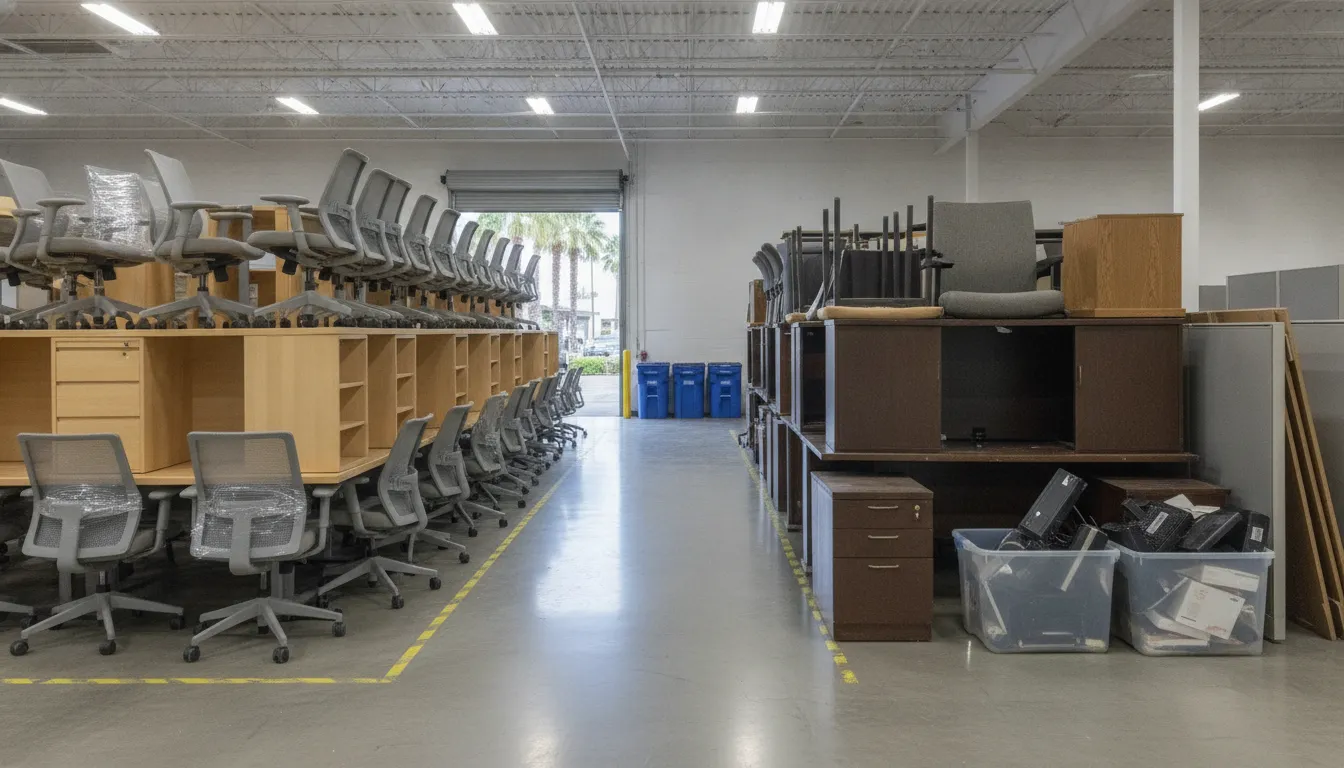
Protect information and company property
Empty every drawer and cabinet before labeling furniture for removal. Search for files, access badges, keys, devices, cables, and personal belongings. Follow your organization’s retention and data-security policies for paper records and electronics. If the project includes computers or other devices, review the separate guide to commercial electronics recycling.
How should desks and office chairs be handled?
Desks and chairs should be emptied, inspected, labeled, and grouped by destination before anyone moves them. Large desks may need controlled disassembly, while adjustable chairs should be secured so they do not roll or shift during transport. Trained movers should handle heavy or awkward pieces.
Office furniture is designed for daily use, not necessarily for easy removal through a narrow doorway. Modular desks can have hidden fasteners. Conference tables may be heavier than they appear. Filing cabinets can tip when drawers open during movement.
Prepare desks and tables
Remove monitors, desk accessories, and loose components. Photograph modular furniture before disassembly if it will be reused. Place hardware in labeled bags and attach those bags to the correct piece. Measure doorways, elevator openings, and tight turns before moving long tables or L-shaped desks.
Prepare chairs, cabinets, and shelving
Lower adjustable chairs and secure loose arms or headrests. Empty cabinets completely, lock drawers when possible, and keep keys with the project lead. Do not move a full filing cabinet. Unsecured drawers and shifting weight increase the chance of injury or damage.
Vets Move Junk provides full-service hauling for approved items, but your staff should not attempt unfamiliar disassembly or heavy lifting simply to save time. The cost of an injury, damaged wall, or disabled elevator can exceed the value of a faster start.
DIY or full-service office furniture removal?
DIY removal can fit a small project with light items, available staff, suitable vehicles, and simple building access. Full-service office furniture removal is usually the more practical choice when furniture is heavy, the timeline is fixed, access is controlled, or employee downtime creates a meaningful business cost.
| Decision factor | DIY removal | Full-service hauling |
|---|---|---|
| Project size | Best suited to a few manageable items | Designed for rooms, departments, or full offices |
| Labor | Uses employee or temporary labor | Uses a hauling crew for agreed work |
| Equipment | Business must source suitable equipment and vehicles | Provider plans equipment and truck capacity |
| Access coordination | Business handles all building logistics | Provider works from the confirmed access plan |
| Operational impact | Can pull staff away from normal work | Helps employees remain focused on their roles |
Look beyond the hauling line item
A fair comparison includes employee hours, vehicle rental, equipment, loading-dock time, potential property damage, and the risk of needing a second trip. It also includes the opportunity cost of asking skilled employees to move furniture instead of serving customers or completing their normal work.
Full-service hauling does not eliminate the need for preparation. Your business still needs to decide what leaves and confirm access. It does, however, place the physical removal work with a team prepared for that job. Vets Move Junk offers a free onsite assessment and explains how volume and job conditions affect junk removal pricing without relying on a fixed online price.
Request your free onsite estimate when you are ready to compare a professional cleanout with the true cost of handling it internally.
How can businesses reduce downtime during a cleanout?
Businesses reduce downtime by dividing the cleanout into zones, scheduling work around low-traffic periods, confirming access in advance, and keeping one decision-maker available. Employees should remove personal belongings and essential equipment before the hauling crew arrives.
Sequence the work by operational priority
Do not begin with the area that is easiest to reach if it is also the area employees need most. Start with vacant rooms, surplus storage, or departments that have already relocated. Leave reception, network areas, and active workstations until their replacement space is ready.
Use visible labels and a simple floor plan so the removal sequence is obvious. Keep hallways, fire exits, and loading paths clear. If a cleanout spans multiple days, define where staged furniture may safely remain between shifts.
Create a removal-day communication plan
Tell employees which areas are affected, when work begins, and where they should report questions. Give property management the crew’s expected arrival window. Share any parking or access instructions with Vets Move Junk before the appointment rather than solving those issues at the curb.
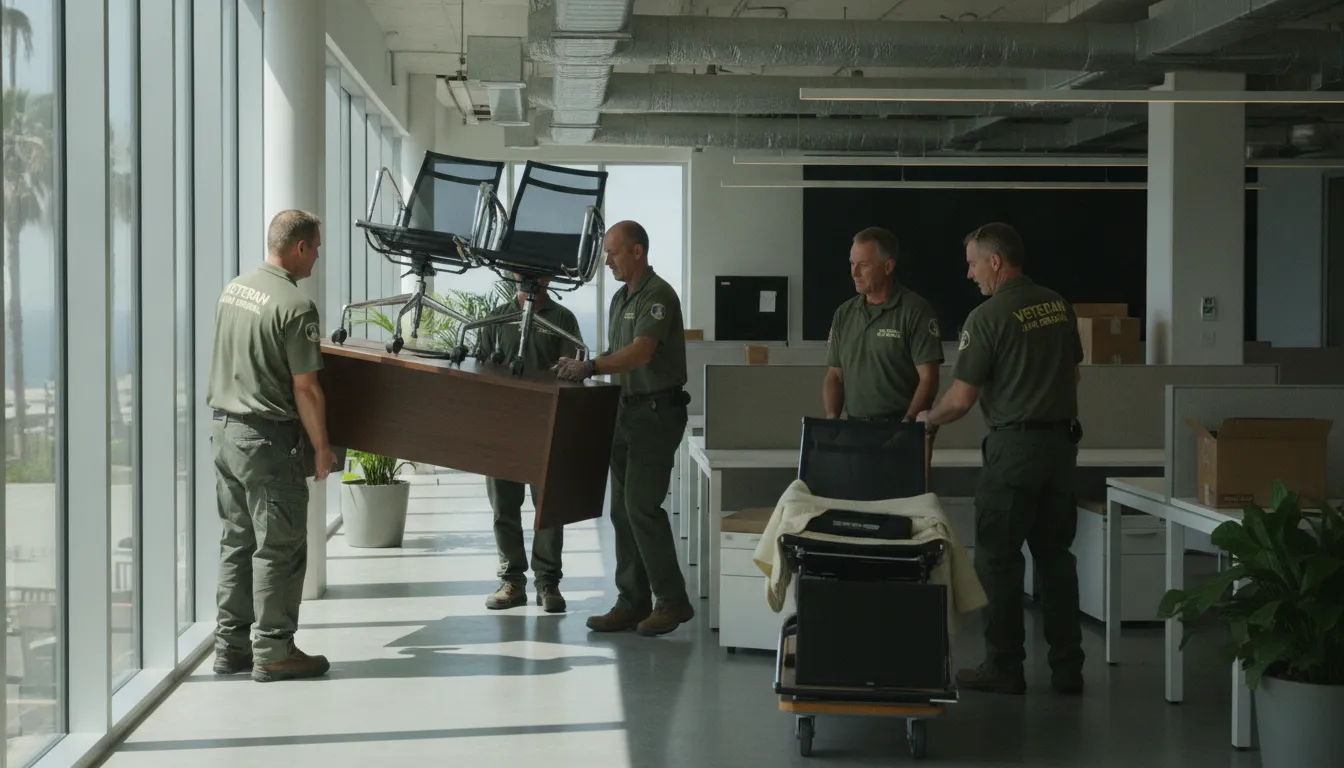
Plan for a final sweep
Reserve time after loading for the project lead to inspect closets, cabinets, break rooms, and utility areas. Compare the cleared space with lease or handoff requirements. Photograph the completed rooms and note any furniture intentionally left behind.
What affects an office furniture removal estimate?
An office furniture removal estimate is shaped by the volume and type of items, required labor and disassembly, stairs or elevator access, loading conditions, and the agreed scope of work. An onsite review lets the provider assess those details before giving a firm price.
Two offices with the same number of desks may require very different plans. One might have direct loading-dock access and modular furniture. The other might have fixed cubicles, limited elevator hours, and a long carry to the truck.
Prepare useful estimate information
- The address, suite, floor, and preferred removal date.
- A room-by-room inventory with photos of oversized items.
- Stair, elevator, hallway, loading-dock, and parking details.
- Building access hours and required paperwork.
- Items requiring disassembly and anything that stays.
- Your preferred sequence if the office must remain operational.
Vets Move Junk provides a hassle-free onsite estimate and pledges to beat a written estimate from a licensed, insured, and bonded competitor. The onsite review is the right time to confirm the precise scope, ask questions, and avoid assumptions about what is included.
A removal-day checklist for facility managers
A short checklist helps the project lead catch the small details that cause the largest delays. Complete it before the crew arrives, then keep a copy available during the cleanout.
- Confirm the inventory. Identify every item leaving and every item staying.
- Verify labels. Make destination labels visible from the main removal path.
- Empty furniture. Remove records, devices, personal belongings, and loose contents.
- Protect operations. Move essential equipment and notify affected employees.
- Confirm access. Recheck elevators, loading areas, parking, security, and building hours.
- Clear travel paths. Keep hallways, exits, doors, and staging areas unobstructed.
- Keep the lead available. Make sure one authorized contact can answer questions.
- Complete a walkthrough. Inspect all rooms after loading and document the result.
Businesses with multiple California offices can review Vets Move Junk service locations when coordinating regional cleanouts. If the project extends beyond furniture, the commercial junk hauling guide covers broader planning considerations.
Frequently asked questions
How do you dispose of old office furniture?
Separate usable furniture from damaged items, then verify whether a receiving organization or facility currently accepts each category. Do not assume every piece can be donated or recycled. A professional hauler can assess the items that remain and explain available removal options.
What is the most efficient way to clear office furniture?
Create an inventory, label each item by destination, assign one decision-maker, reserve building access, and schedule the work around operations. Full-service hauling can be efficient when heavy lifting or a fixed handoff date would otherwise pull employees away from normal work.
How do office furniture removal services work?
The provider reviews the furniture, labor requirements, building access, and truck volume before presenting an onsite estimate. Once the scope and estimate are approved, the team completes the agreed disassembly, lifting, loading, and removal.
What affects an office furniture removal estimate?
Volume, item type, disassembly, labor, stairs or elevator access, loading distance, and job conditions all matter. Because office layouts vary, an onsite assessment is more dependable than a generic fixed price.
Clear your office with less disruption
A successful office cleanout is measured by more than an empty room. It should protect employees, preserve building access, support the move schedule, and leave the business ready for its next step. Vets Move Junk combines local California service with a practical onsite planning process for approved office furniture and related junk.
Get your free onsite estimate from Vets Move Junk and build an office furniture removal plan around your timeline.