Pallet recycling in California is usually a sorting and planning decision before it is a hauling decision. A business should separate sound pallets from repairable, broken, wet, contaminated, and plastic material, confirm ownership, and ask the receiving program what it accepts. This guide explains how to prepare pallets for reuse, recycling, or professional pickup without assuming every load has the same destination.
Get a free onsite estimate for business pallet pickup
What does pallet recycling mean for a California business?
Pallet recycling means finding the highest practical recovery route for each pallet, starting with return or reuse, then repair or component recovery, and finally an accepted wood or plastic recycling stream when reuse is not realistic. The correct route depends on the pallet’s material, condition, ownership, and the receiving facility’s current rules.
For a warehouse, distributor, retailer, manufacturer, contractor, or property manager, the goal is not simply to move a pile from one place to another. The goal is to keep usable assets in circulation, prevent damaged material from creating a safety problem, and give a recycler or removal provider enough information to plan the load responsibly.
CalRecycle classifies clean pallets and crates as unpainted wood pallets, crates, and packaging made from lumber or engineered wood. That definition is useful for sorting, but it does not mean that every pallet in a business yard belongs in the same recovery stream. Paint, chemicals, food residue, soil, moisture, mixed materials, and unknown prior use can affect acceptance.
California businesses should therefore treat pallet recycling as a conditional plan. Confirm the next step with the owner, supplier, recycler, or removal provider instead of advertising a guaranteed recycling result before the load has been inspected.
Can wooden and plastic pallets be recycled?
Wooden pallets may be reusable, repairable, or suitable for wood recovery, while plastic pallets may require a separate program that accepts the specific plastic type. Businesses should not mix wood, plastic, composite, metal, and contaminated material when preparing a recycling inquiry because mixed loads are harder to evaluate and may be rejected.
Wood pallets are often the easiest group to assess visually. Look for broken deck boards, split stringers, exposed nails, major warping, mold, oil, chemical residue, and unstable stacking. A sound pallet may be returned to a supplier, kept for internal use, or accepted by a pallet repair or resale operation. A damaged pallet may still have recoverable boards or may be accepted as wood waste, but that decision belongs to the receiving program.
Plastic pallets need a different question: does the program accept this material and configuration? Separate plastic pallets from wood and keep any visible identification, ownership, or supplier markings available for review. Do not assume that a local curbside recycling program, transfer station, or wood recycler accepts commercial pallets.
The same principle applies to composite pallets, pressboard packaging, and pallets with attached metal or plastic parts. Describe the load accurately and ask for acceptance instructions before transporting it. A receiving facility may request photographs, material details, estimated quantity, or a separation plan.
How should a business sort pallets before recycling or pickup?
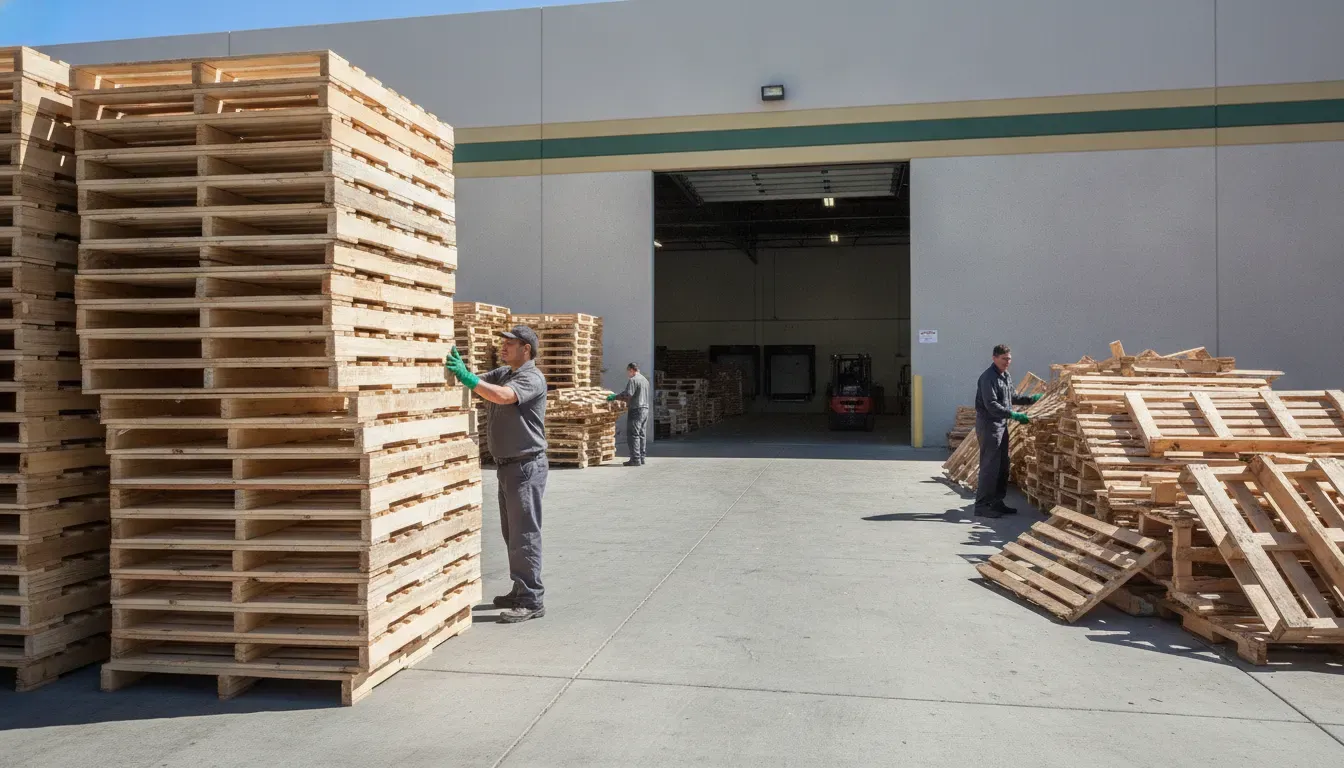
Sort pallets into a small number of clear groups based on condition and material. The fastest useful system is one that a warehouse team, supplier, recycling program, and removal crew can all understand without guessing. Keep each group stable, accessible, and away from blocked exits or active equipment paths.
| Pallet condition | Possible next step | Business preparation |
|---|---|---|
| Clean and structurally sound | Return, reuse, repair review, or resale inquiry | Stack safely, confirm ownership, and keep the group separate. |
| Usable with minor wear | Internal secondary use or repair program | Record the size and keep loose boards or exposed fasteners out of the stack. |
| Broken, split, or unstable | Component recovery, wood recycling inquiry, or removal | Isolate the group and protect people from nails, splinters, and collapse hazards. |
| Wet, moldy, oily, or contaminated | Receiving-facility review before any recycling decision | Keep it away from clean wood and disclose the condition before pickup. |
| Plastic or composite | Material-specific recycling or return inquiry | Separate from wood and identify the material when possible. |
This table is a planning tool, not a promise of acceptance. A recycler may use different grades or may decline a load based on condition, volume, contamination, or transportation distance. If the business is unsure, take clear photos and ask for instructions before dismantling, loading, or combining the pallets with other materials.
What are the steps for preparing pallets for recycling?
Businesses can make pallet recycling easier by documenting the load before moving it. A short preparation process reduces avoidable delays and prevents valuable or returnable pallets from being treated as unwanted material.
- Confirm ownership. Check whether the pallets belong to a supplier, customer, rental pool, carrier, or the business itself. Mark returnable or inventory-related pallets so they are not removed accidentally.
- Separate by material. Create distinct groups for wood, plastic, composite, and other packaging. Do not bury damaged pallets inside a clean stack or place loose wood in a plastic group.
- Inspect condition. Note broken boards, protruding nails, unstable stacks, moisture, mold, oil, chemical residue, and food or soil contamination. Share unusual conditions before requesting a recycling or pickup route.
- Estimate the quantity. Count pallets when practical, then estimate the footprint and height of each group. Photos from several angles are often more useful than a vague description such as a large pile.
- Document unusual material. Note paint, treatment markings, moisture, mold, food residue, oil, chemical history, or attached parts. Keep these notes with the photos so a receiving program can review the load accurately.
- Ask about acceptance. Contact the intended recycler, supplier, or removal provider with the material, condition, quantity, and desired outcome. Wait for instructions before assuming the load will be recycled.
Do not dismantle pallets just to make a pile appear smaller. Pulling boards apart can expose nails and create additional handling work. Unless the business has the right training, tools, and approved process, leave dismantling and loading to the party that accepts responsibility for that work.
Which pallet conditions can prevent recycling?
Contamination, unsafe damage, and uncertain material identity are the most common reasons a pallet load needs additional review. A recycling program may accept clean wood but reject pallets soaked with oil, coated with unknown substances, infested, heavily moldy, or mixed with materials it cannot process.
Some conditions are easy to miss in a large commercial pile. Inspect the bottom layers, look between boards, and check whether rainwater or leaking containers has affected the stack. If the pallets came from food, chemical, agricultural, industrial, or construction operations, describe the prior use honestly. A professional receiving facility needs accurate information to determine whether it can accept the load.
Do not place suspected hazardous materials, leaking containers, chemicals, fuel, batteries, or other restricted items on a pallet and call it ordinary wood recycling. Set unusual materials aside and contact the appropriate local program or service provider for instructions. Vets Move Junk can review the general removal scope, but acceptance of a restricted material must be confirmed before pickup.
CalRecycle’s business-focused publication, Wood Waste: Keep it Out of Landfills, provides reuse and recycling guidance for business wood waste. Use it as a starting point, then verify current instructions with the facility or program that will receive the specific load.
What should a business ask before arranging pallet recycling?
Before arranging pallet recycling or removal, ask questions that clarify the material route. A reputable provider should be able to explain what information it needs to review the load, what conditions may change acceptance, and whether the service is a recycling inquiry, a return, a recovery effort, or general removal.
- What materials do you accept? Ask separately about clean wood, broken wood, plastic, composite, painted, treated, wet, or contaminated pallets.
- What condition standards apply? Find out whether exposed nails, mold, food residue, soil, oil, or chemical history affects acceptance.
- Do you need a count or photographs? Prepare a simple inventory and show the full load, not only the best-looking pallets.
- What ownership proof is needed? Keep supplier, rental-pool, or customer information available for pallets that may need to be returned.
- What outcome can you confirm? Ask whether the material will be reused, repaired, sent for recovery, or simply removed, and avoid relying on an unverified recycling promise.
These questions protect the business from a mismatch between the requested service and the actual load. For dock, gate, scheduling, and loading details, use Vets Move Junk’s pallet removal planning guide rather than repeating those logistics here.
Talk with Vets Move Junk about your California business pickup plan
When is professional pallet pickup more practical than self-hauling?
Professional pickup can be practical when pallets are numerous, unstable, mixed with other commercial junk, or part of a larger warehouse cleanup. It can also help when the business has confirmed the material needs removal but does not have the staff, equipment, or vehicle to handle the load safely.
Self-hauling may make sense for a small, clean, accepted load when the business has a suitable vehicle, trained staff, and confirmed receiving instructions. It becomes less attractive when staff must lift damaged pallets or travel without knowing whether the facility will accept them.
Vets Move Junk provides commercial junk removal and warehouse cleanout support across its California service markets. Its full-service model covers the labor and loading portion of a removal project, while the final disposition depends on what the material is, what the receiving options accept, and the scope confirmed during the estimate. The company can discuss pallet removal as part of a larger commercial cleanup, but businesses should not treat an estimate as a guarantee that every pallet will be recycled.
How is pallet recycling different from pallet removal?
Pallet recycling focuses on the material decision: reuse, repair, return, component recovery, or an accepted recycling stream. Pallet removal focuses on safely getting unwanted pallets out of a business location. One project may need both, but the two goals should be kept distinct so the business does not assume that a removal provider controls the final recycling destination.
For pickup planning, read Vets Move Junk’s pallet removal guide for California businesses. That article covers staging, access, scheduling, and removal logistics. This guide adds the condition-sorting and reuse-versus-recycling framework that should come before the pickup conversation.
For a broader warehouse project, the commercial warehouse junk removal guide explains how pallet overflow can fit into a larger cleanout. Keeping the articles separate helps a business find the right next step instead of treating every pallet question as a single service problem.
How can Vets Move Junk help with a pallet cleanup?
Vets Move Junk can help California businesses plan the removal side of a pallet cleanup, including labor, loading, hauling, and clearing space around a commercial or warehouse project. The team can review the type of material, approximate volume, access conditions, and other junk that needs to leave before providing an onsite estimate.
When requesting an estimate, share the pallet count or photos, condition groups, material types, ownership concerns, staging location, dock or gate details, and any restricted or unusual materials. This gives the team a clearer picture of the work and helps separate a pallet-only pickup from a broader commercial cleanout.
Vets Move Junk uses volume-based, all-inclusive estimates for junk removal rather than publishing a fixed price for an uninspected pallet load. Recycling or recovery is not guaranteed in advance. The responsible route depends on the material and the available receiving options at the time of service, so ask what can be confirmed for your specific project.
Request your free onsite estimate for pallet removal and commercial cleanup
Frequently Asked Questions
Are wooden pallets recyclable in California?
Wooden pallets may be reusable, repairable, or suitable for an accepted wood recovery program, depending on their condition and the receiving facility’s rules. Clean, unpainted wood is easier to evaluate than wet, moldy, painted, oily, or contaminated material. Separate the pallets by condition, confirm ownership, and ask the intended program or provider what it accepts before transporting them.
Where can a business recycle pallets?
A business may be able to return pallets to a supplier, use a pallet repair or resale operation, contact a commercial wood recovery program, or arrange a provider that handles the removal scope. The right option depends on material, condition, quantity, location, and ownership. Do not assume that a residential curbside program or general recycling bin accepts commercial pallets.
Can broken pallets be recycled?
Broken pallets may still have recoverable boards or may fit an accepted wood recovery stream, but recycling is not automatic. Separate broken pallets from clean reusable ones, keep protruding nails and unstable stacks away from walkways, and disclose the condition before pickup. A receiving program must decide whether it can repair, dismantle, chip, or otherwise process the material.
Can plastic pallets go in wood recycling?
No. Plastic pallets should be separated from wood and sent only to a program that accepts the relevant plastic material and pallet type. Keep composite and mixed-material pallets separate as well. If the material marking is unclear, take a photo and ask the receiving facility for instructions rather than mixing the pallets into a wood load.
Should a business remove nails before recycling a pallet?
Not necessarily. A business should not dismantle pallets or pull nails simply to prepare a recycling load unless it has an approved process, trained staff, and the proper tools. Loose boards and exposed fasteners create handling risks. Isolate damaged pallets, report their condition, and confirm whether the recycler or pickup provider wants the pallets intact or prepared in another way.
What information should I provide when booking pallet pickup?
Provide the approximate count, pallet material, condition, photographs, ownership concerns, staging location, access details, and any other commercial junk included in the project. Mention wet, moldy, oily, chemical, food-related, or unknown-use pallets before the estimate. Clear information helps Vets Move Junk evaluate the labor and removal scope without promising a recycling destination it cannot verify in advance.
Plan the next step for your pallet load
Start with a safe sort, confirm what belongs to the business, and ask the receiving program or removal provider what it can accept. If the pallets are mixed with warehouse overflow or other commercial junk, a full-service estimate can help you plan the cleanup without making an unverified recycling promise.